
Key Takeaways
- The proposal is aimed at business-to-government and business-to-business workflows where identity and authority are still repeatedly checked, re-entered, and re-proven.
- The real heart of the proposal is not organisation identity alone. It is the mandate layer: who is allowed to act, sign, submit, or receive something on behalf of the organisation.
- The clearest early value shows up in KYB, licensing, procurement, tax and administrative processes, and other repeated workflow bottlenecks.
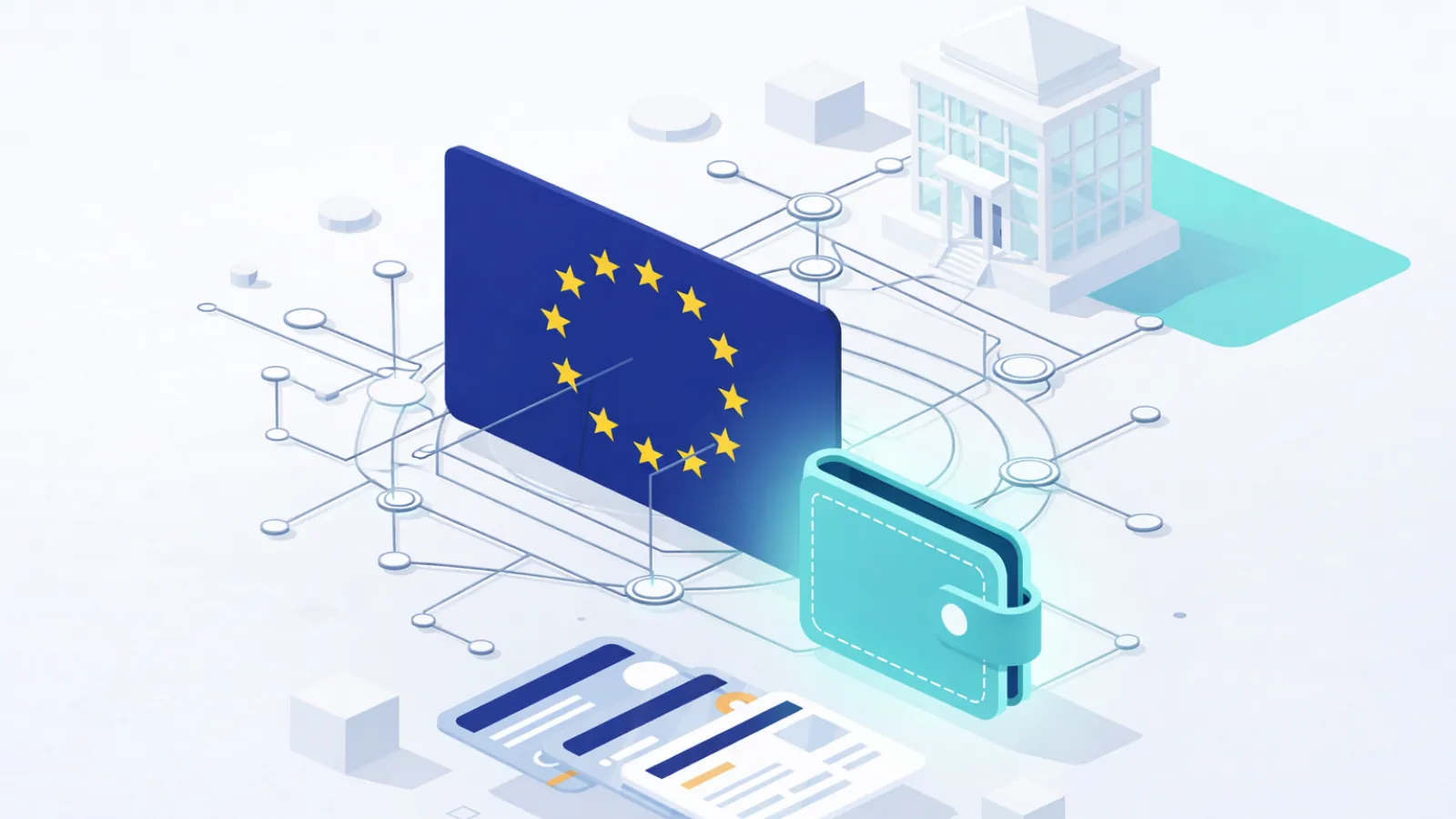
The EU is not only building wallet infrastructure for citizens. The EU Business Wallet proposal creates a separate rail for business identity, delegated authority, and cross-border workflows. The important shift is not that companies get another place to store data. It is that identity, authority, and document exchange move through a more reusable and regulated trust model.
Executive Summary
- The proposal is aimed at business-to-government and business-to-business workflows where identity and authority are still repeatedly checked, re-entered, and re-proven.
- The real heart of the proposal is not organisation identity alone. It is the mandate layer: who is allowed to act, sign, submit, or receive something on behalf of the organisation.
- The clearest early value shows up in KYB, licensing, procurement, tax and administrative processes, and other repeated workflow bottlenecks.
- Even if the regulation advances, adoption will still depend on whether teams can map the wallet to painful workflows and show better outcomes than the status quo.
What This Is About
Business identity is moving from repeated manual checking toward workflow infrastructure. The practical question is not whether a company can be named in a wallet. It is whether that wallet can carry enough trusted context to make real business processes move faster across borders and institutions.
That is why the proposal matters most in places where teams repeatedly ask the same questions:
- who is this organisation?
- what can it prove about itself?
- who is allowed to act for it?
- can we trust that authority without starting from zero again?
If those questions can be answered in a more reusable way, the impact is operational, not cosmetic.
Mandates Are the Real Story
The strongest point is that this proposal is not just about business identity. It is about delegated authority.
That matters because many business processes do not fail on “who is the company?” alone. They fail on “who is allowed to do this on its behalf?” A company may be easy to identify in principle, but much harder to work with when signing authority, submission rights, and role delegation are still fragmented across manual steps, local rules, and repeated checks.
That is where mandates become the real design problem. Once authority becomes portable, teams have to think about:
- who grants it
- how it is delegated
- how it expires
- how it is revoked
- what evidence trail remains behind it
That complexity is exactly why this proposal matters. It pushes business identity from a record-checking problem into a workflow problem.
The First Value Shows Up Where Friction Already Hurts
The proposal becomes easier to understand when viewed through the workflows it is trying to improve. The most obvious candidates are the ones where organisations repeatedly prove identity, status, and authority under time pressure or regulatory pressure:
- KYB and business onboarding
- licensing and permits
- procurement and cross-border public processes
- formal document submission and notification flows
These are not edge cases. They are some of the places where manual checking, fragmented evidence, and unclear authority create the most repeated drag today.
That is why the EU Business Wallet should not be treated as a theoretical identity project. Its strongest case is operational. If it works, it reduces the cost of re-proving the same business facts and delegated rights across repeated interactions.
Why This Matters for Product and Compliance Teams
For product teams, the implication is that “verify the company” will no longer be enough as a framing. Workflow-grade business identity means modelling identity, attestations, and authority separately and then reconnecting them inside a usable process.
For compliance and trust teams, the proposal raises a different question: what should become reusable, and what must still remain tightly contextual? Not every business claim should travel with the same weight, and not every delegated authority should be portable in the same way.
For wallet and credential teams, the practical issue is that business wallets will only work as well as the source layers behind them. If organisation data, role assertions, and mandate evidence are weak or inconsistent, a wallet will not solve the deeper trust problem. It will just move it.
Regulation Can Create the Rail, Not the Demand
One of the easiest mistakes in this space is to treat regulatory structure as the same thing as market adoption. It is not.
The proposal can create a legal and technical route. It can define wallet roles, public-sector obligations, and a stronger baseline for business identity interactions. But it still does not guarantee real use. Use comes when the wallet maps to a workflow painful enough that teams want the change.
That is why the commercial angle should be handled carefully. The more important opportunity is not the existence of a new regulated wallet market. It is the fact that identity, authority, and cross-border friction already hurt enough in some workflows to justify a better model.
Why This Matters
Business identity often gets treated as a future extension of the citizen-wallet conversation. It should be taken more seriously than that. Business identity and mandates are becoming their own rail, and teams that wait too long may end up designing for yesterday’s proofing model while the market shifts toward reusable authority and workflow-native trust.
This is one of the clearest places where the EUDI conversation touches real operating models. The business-wallet question is not only policy. It affects onboarding, procurement, regulated submissions, and how organisations prove who can act for them in practice.
This connects naturally with EWC Outcomes: What the LSP Results Mean for Adoption Now, which frames pilot outcomes as adoption evidence, and State of EUDI: January 2026, which shows why legal timelines and practical readiness rarely move in perfect sync.
Recommended Next Actions
- Map one high-friction workflow first instead of trying to model the whole organisation.
- Separate organisation identity, organisational attributes, and delegated authority in your design.
- Treat the acting-person and mandate layer as a core product problem, not a footnote.
- Decide where business-wallet acceptance would create the clearest measurable value.
- Sequence implementation around one workflow and one authority pattern before expanding.
- Keep the market opportunity grounded in workflow pain, not in regulation alone.
Sources
- EU Business Wallet article, carousel, and proposal notes
- Related adoption lessons from the broader EUDI material prepared in this workspace
Next Actions
- Validate whether this insight changes your current roadmap assumptions.
- Identify one dependency to verify with product, legal, or architecture this week.
- Turn one takeaway into a concrete implementation decision.
Strategy Call
Want to turn this into a practical next step?
Whether you're shaping identity strategy, wallet adoption, or product direction - let's discuss what makes sense.
Prefer LinkedIn? Message me there .
Related Insights
The State of the EU Digital Identity Wallet in Early 2026
A practical webinar recap on where the EUDI Wallet stands as national implementation moves from regulation and pilots into certification, relying party readiness, and adoption planning.

EWC Outcomes: What the LSP Results Mean for Adoption Now
EWC makes one thing clear. Standards and deadlines do not close the adoption gap by themselves. The hard work is trust, consumer-grade UX, a workable economic model, and early B2B value.

Wallet Requester Trust Should Not Depend on the User Catching the Problem
Small design choices around requester registration, machine-readable intent, and default enforcement determine whether the wallet actually protects users or simply warns them after the fact. If too much depends on the user noticing misuse in real time, the protection model is still too weak.